
by Dr. Lori Verderame
Nathaniel Currier and James Merritt Ives were successful American printmakers in New York City in the late 19th Century. They were best known for their production of hand colored lithograph prints based on paintings by artists of the day and scenes of everyday life.
Lithography is a popular printmaking process that loosely translates to mean “writing on stone”. Lithography is often referred to as stone lithography however the term lithography assumes that the image is prepared on a stone surface. Introduced in 1796 in Bavaria, lithography was first done on limestone since limestone has the same response to grease and water. Drawing on the stone is done with grease or wax and then the stone is dampened, and the ink adheres to the greased areas. The wet areas receive paper which is laid upon the damp stone and then pressure is applied to the paper against the stone. When the paper is pulled off the stone’s surface, a print image is revealed. Prints are often referred to as “pulls” as the paper is pulled from the stone’s surface to show the print’s image. Lithography is often hand colored which is called hand colored lithography.
Currier & Ives lithograph prints were hand colored after being printed in ink using stones. The images were printed onto thick, woven light-colored papers using the lithography process from the firm’s New York city studio. Currier & Ives produced large (14 x 20 inches or larger), medium (10 x 14 inches to 14 x 20 inches) and small (8 x 12 inches) format prints which were widely known and collected. If your print is a different size that the large, medium, or small format print sizes provided above, then you may have a reproduction. If your print is not one of those sizes, that may also mean that your print has been cut down from the typical sheet size or perhaps your print has been otherwise altered. An expert like me who has reviewed many of Currier & Ives works can tell the difference by looking at your print.
The large format Currier & Ives prints were completed by skilled colorists and these prints demonstrated a neat application of hand coloring which were not visible on the prints of smaller formats. These large format prints are more desirable on the market today than their smaller counterparts. It is common that the smaller format prints usually have sloppy and less detailed hand coloring. It is not widely known but Currier & Ives produced rare, uncolored lithograph prints. Identifying valuable prints can be difficult and there are many factors that go into spotting a fake and confirming value in today’s active print market.
There were other printers who reproduced Currier & Ives prints including Joseph Koehler, S. Lipshitz, Max Williams, and Andres Inc. Most reproductions which can still have value show light hand coloring on thin sheets of paper.
What to Look For
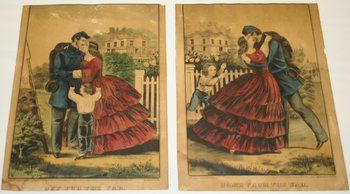
Currier & Ives prints have neat, hand coloring on a piece of paper hosting a lithograph print. Prints are impressed on heavy or thick woven paper.
The paper on an original Currier & Ives print should look matte or flat to the eye. Paper supporting Currier & Ives color lithographs should not appear shiny.
Look for the correct size–small, medium, or large format prints.
Original Currier & Ives prints are very valuable. Some have sold for $100,000 or more. Well executed reproductions of Currier & Ives images also bring high values with prices in the thousands to tens of thousands of dollars each.
Good condition, recognizable images of sporting events, historical figures, and winter scenes are valuable.
Artists working for the firm are another way to spot a true Currier & Ives print.
There were many, mainly American artists, who worked creating imagery for the firm of Currier & Ives. While Currier & Ives produced and published more than one million hand colored lithographic and other prints from circa 1835 to 1907, the firm employed artists to create scenes that have become synonymous with Americana in the late 19th century. Some of the better-known Currier & Ives artists included:
George H. Durrie was an American landscape artist who worked for Currier & Ives. Durrie was an artist who made his impact painting winter scenes and the four seasonal scenes for Currier & Ives. Durrie’s work is among some of the most recognizable images in the Currier & Ives realm.Louis Maurer, like many of the artists working for Currier & Ives, produced genre scenes and other scenes of everyday life. These lithographs were very popular with collectors of Currier & Ives prints. Frances Flora Bond Palmer was an artist who worked with Currie & Ives producing imagery and designed hundreds of Americana images, including picturesque panoramas and vista images of the American landscape. Palmer was the first American woman to make her living as a full-time working artist. Arthur Fitzwilliam Tait was a well-known and popular artist of the late 19th and early 20th centuries whose artwork featuring sporting scenes and athletes was highly sought after. The American cartoonist, Theodore Worth, worked for Currier & Ives and produced political style cartoon and other imagery for the firm’s color lithographs. Other artists who were associated with the Currier & Ives firm include John Cameron, Otto Knirsch, Charles Parsons who also served as the art director at Harper’s magazine, and Napoleon Sarony.
Currier & Ives was a lithography publisher that produced over a million hand-colored prints from 1835 to 1907. The firm’s work is so important in creating images of 19th-century America that the firm’s name has become associated with the time period.
Use a magnifying glass to see if your Currier & Ives image has a small dot pattern throughout. If so, you have a print that was produced after the heyday of Currier & Ives print production. These prints have value.
Framing of Currier & Ives prints were consistent with the style of the time. Most Currier & Ives frames are housed in wooden ogee frames of walnut, oak, or cherry hardwood.
As part of an evaluation for your piece, make sure you have a lithographic print and not a mechanical print or an inexpensive color poster. Dr. Lori can help you understand the difference between a print and poster.
Get an online appraisal of your Currier & Ives print from Dr. Lori.