by Dr. Lori Verderame
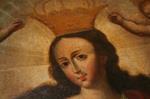
The art of the Cuzco School relates to style of Peruvian art that was prevalent after the conquest of Peru by the Spaniards. While largely unknown by name, the Cuzco School artists painted predominantly for private use and to have their largely religious works displayed in churches and cathedrals. The city of Cuzco was the ancient capital of the Incas in Peru. During the period of Spanish Colonization in South America, Cuzco was an important locale for art and worship. Cuzco is a city, once the capital of the Incan empire, located about 365 miles southeast of Lima, Peru. The Incas dominated the region until the time of the Spanish conquest in 1532. The style of religious painting of the famed Cuzco School of artists reached its zenith during the 17th and 18th centuries as the Spanish colonized the area. Cuzco School paintings featured religious figures such as the Virgin Mary, the Archangels Michael and Gabriel, St. George and the Dragon, among others. The paintings also highlighted the acts of regional saints, local figures, and others.
How to Tell
Spanish colonial art flourished in the New World between the mid-16th and early-19th centuries, especially in Mexico and Peru, where native artists developed distinctive regional styles by combining native subjects with European artistic traditions. Peru’s colonial art tradition began in Cuzco, the former capital of the empire of the Incas. Soon, Cuzco became the main art center in the Andes highlands. The mestizo-baroque style that emerged there in the mid-17th century came to be called the Cuzco School. Characterized by elements such as direct portraits of the Virgin Mary, regional saints, and other figures, the style was best known as that of the Cuzco artists. Cuzco art, which is typically oil on canvas, has repeating patterns, dramatic poses and facial characteristics, and direct compositions. Some of the tell tale signs of an authentic work by the Cuzco school artists are floral borders, vivid coloring, gold tooling, and gold-leaf overlay called brocateado de oro. The mestizo-baroque style became more elaborate as time went one and flourished during the 17th and 18th centuries in Peru.
Some of the most popular subjects in Cuzco School paintings are the Madonna and Child, St. Michael with his attributes, St. Gabriel, St. George and the Dragon, St. Lucy, St. Agatha, the saints gathered together in a sacred conversation, a.k.a. sacre conversacione, and others.
Background of the Incas
The background of the Incas is fascinating and helps explain why Cuzco School paintings look the way they do and why collectors are so interested in them. The Incan civilization peaked from circa 1438 to 1533. Best known for its riches in gold and the historic site of Machu Picchu which was intended as a palace for one of the Incan emperors. Today, Machu Picchu is a pilgrimage spot on the bucket list of many worldwide. It is likely that an outbreak of small pox was the reason that Machu Picchu was abandoned. In 1911, Hiram Bingham, a Yale professor, discovered the great lost Incan site and began studying it which lasted many years.
The city of Cuzco, Peru was the thriving epicenter of the Incan empire. It was Cuzco that made the Incas well known for their accomplishments in masonry, engineering, and architecture. They used no mortar in some of their construction including the famed 12-sided stone. Stones were moved by men. The Incan trade routes and vast road network assisted with the movement of goods. There were 20,000 miles of roads within the Urubamba River Valley of Peru and some of these routes made use of rope bridges. This was true in Quito, Ecuador to Santiago, Chile.
Incans were expert craftsman and designers. Much of the art work of the Incas was made in gold. They produced jewelry to show their status, abilities to make jewelry, and wealth. For the Incas, images of adornment obviously referenced the abundance of gold available to the Peruvians as well as their social status. The famous Moche Gold Mask from 100-700 AD showed that there was much gold to be had in the Incan empire. Some of the most popular and famous objects from the Incas are of gold.
The Incas, like the Aztecs and the Mayan of South and Central America, worshipped various gods. The variety of gods helped the civilization address their needs and concerns. For instance, the Inca’s supreme god was Viracocha. Viracocha had the ability to produce or birth other gods with powers. The God of the Sun was named Inti. The Sun was such an important part of the Incan civilization’s prosperity that the Incas built the famed golden palace to pay homage to Inti, the revered God of the Sun.
On the other hand, the God of the Rain was called Illapa. Illapa, in the dry mountains of the Andes of Peru, was vitally important to the long existence of the Incas. Worshipping Illapa was critical to the civilization’s success and growth. Other gods and goddesses also played key roles in the realm of the Incas. For example, the Earth Goddess Pachamama served as protector of the Earth and as the goddess of fertility. In order to honor the gods, the Incans would sacrifice animals, particularly llamas, and other creatures.
The Spaniards dismantled much of Cuzco and left only some minor evidence of their architecture. The Spaniards melted down much of the gold of the Incas which were characteristic items of the culture. Today, the gold of the Incas is rare and highly sought after.
The collapse of the Incan civilization came with the arrival of the Spanish conquistadors. The Spaniards plundered the city of Cuzco. They ravaged and took Cuzco’s gold stores that were part of its long history. Civil war and the take over of Cuzco by the Spanish that took place from 1526 to 1572 were devastating. In addition, diseases including small pox overtook the Incan empire by the end of the 1500s. The Spanish warriors who were sent to Meso-America were told by the ruling Spanish King and Queen, King Ferdinand of Aragon and Queen Isabella of Castille, “to get gold…at all hazards (costs), get gold!” This was the same message they gave Christopher Columbus when he embarked on his journey in search of the New World. For centuries, the Spanish took the gold from Central and South America and brought it back, by galleons sailing in flotillas or fleets of treasure ships, sailing to the motherland of Spain.
The earlier indigenous people that were in Central and South America during the age before the landing of Columbus or the Pre-Columbian age included the Olmec, whose civilization flourished near Vera Cruz, Mexico and dates to circa 1400 BC. The Olmecs enjoyed vast trade networks but by 300 BC, they vanished. Like the Olmec, another early people in the area were the Chavin people. The Chavin people are less well known when compared to the Olmec or the Incan but as precursors to the Incan people, the Chavin were active in the area about 900 BC. Collectors look for items from these civilizations and pay high prices for the pieces.
Get an online appraisal of your Cuzco School painting from Dr. Lori.